
Track Record in Machining
- By leveraging our extensive network of local manufacturing partners, we can handle a wide range of machining processes, including cutting, cold heading, and surface treatments such as plating.
- As a trading company, we utilize our strengths to select the most suitable manufacturing
equipment and processing methods based on the intended application. - For urgent requests, we provide quotation within 24 hours and offer standard manufacturing lead times ranging from one to ten days.
Our company also handles cut-machined products manufactured using NC lathes and machining centers, with a level of experience comparable to our track record in header- processed products.
Even for identical products, the required precision may differ depending on the application.
To meet the specific needs of each user, we carefully select the most suitable machinery and
provide detailed technical support in accordance with customer requirements.
We offer Optimal Precision and Pricing for Your Application
| Overview | Overall length: 18 mm / Double-ended screw: M3 / Milled head / Material: Brass (Ni plated) The head (“–” type) is a spacer used for semiconductor substrate assembly. |
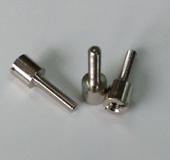
Although the product dimensions are the same, the production lot was divided into two categories based on required precision.
・Lots requiring ultra-fine dimensional accuracy depending on the customer’s equipment
・Lots requiring cost-effective production within standard tolerances in accordance with JIS B 0405
To meet these needs, we selected the machining equipment accordingly and provided the requested precision and pricing for both types of lots.
| Precision | Machine | Quantity | |
| High (Tolerance 0.01) | NC Lathe | 500 | |
| Standard (Tolerance ±0.2) | Cam-type Automatic Lathe | 500 |
We Delivered a Product Requiring Multiple Processing Steps Through Our Local Network
| Overview | Overall length: 36 mm / Screw section: M6 / Body polished / Material: Steel (Both ends PK) |
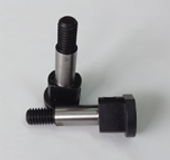
This is a special-size screw used in industrial machinery.
After forming on a NC lathe, the screw undergoes heat treatment, PK processing, body polishing, with four different factories involved in the process.
This is a case that showcases the collaborative strength unique to the Higashi-Osaka and Yao regions, where specialized functions are concentrated.
| Quantity | Unit Price |
| 500 | |
| 1,000 |
These special screws, manufactured through such processes, are used in our customers' final products.
We take great pride in the fact that the expertise of local manufacturers contributes to society. At the same time, all our employees feel a strong sense of responsibility in being involved in such important work.
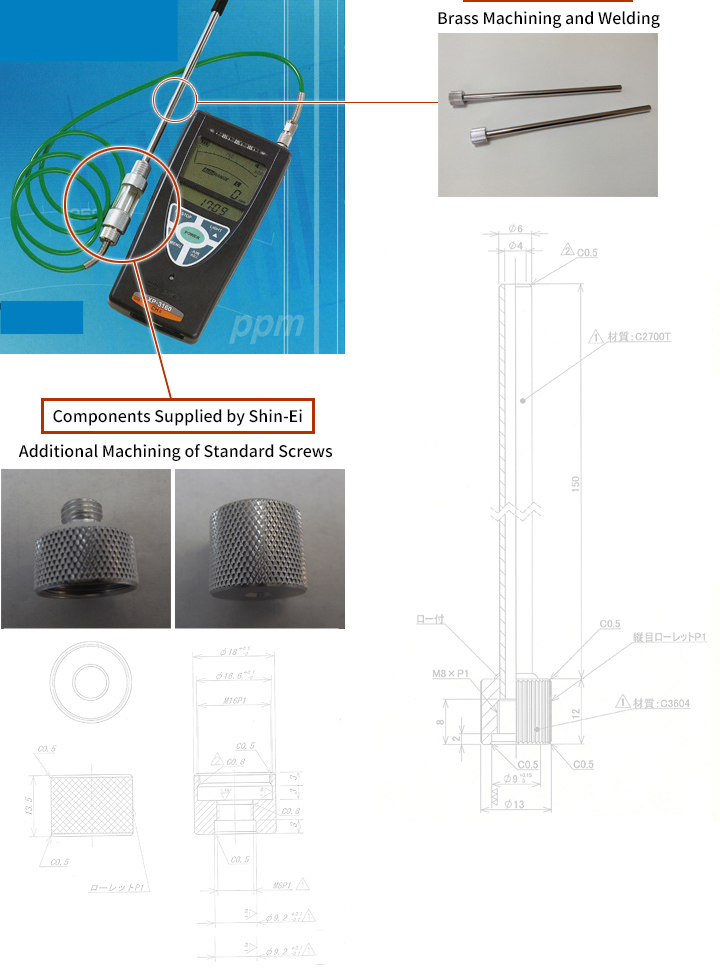
Examples of Mass-Produced Products Requiring Strict Manufacturing and Quality Control
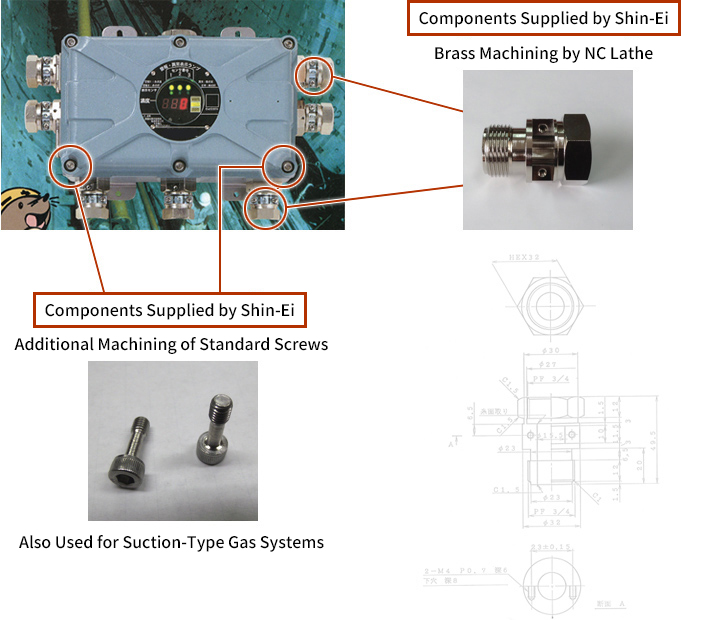
Suction-type gas detection device
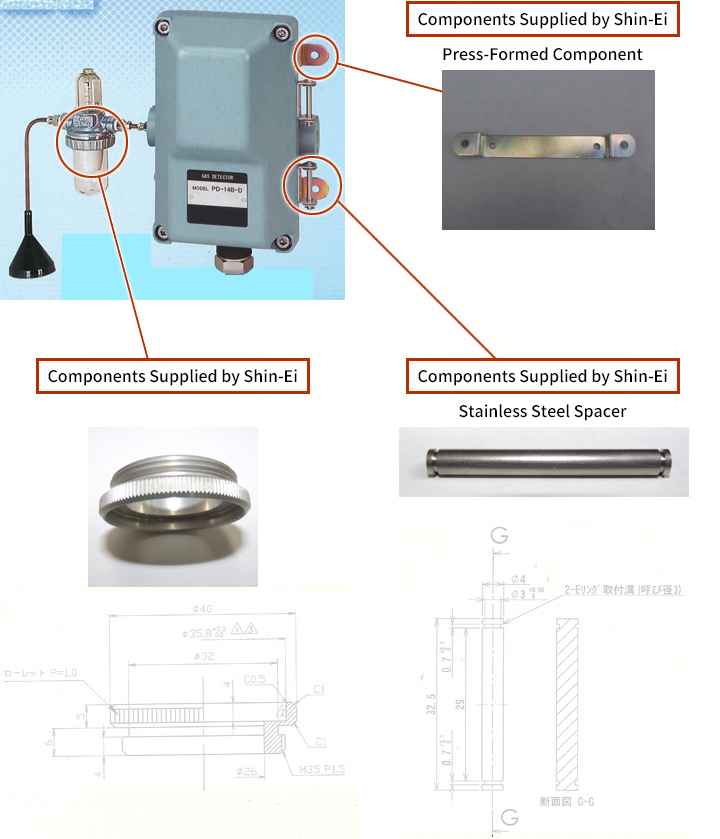
High-sensitivity combustible gas detector
Machining Equipment
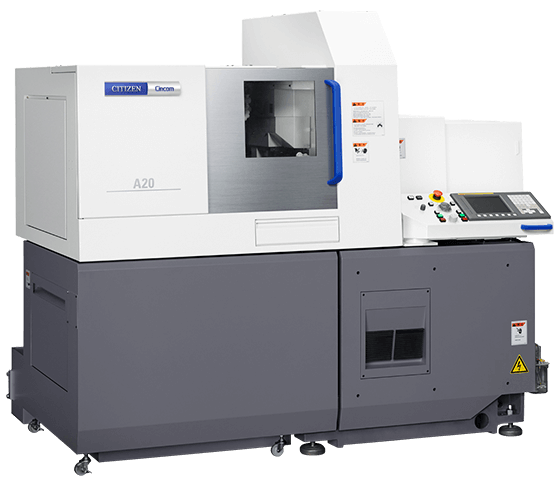
Below are examples of NC lathes, multi-functional turning centers, machining centers, and other cutting machinery used at our partner manufacturing facilities.
| Cutting Machine | Manufacturer (Model) | Material Size | Quantity |
| Composite Machining Center | Mori Seiki NL2500M | φ300×700 | 1 unit |
| Composite Machining Center | Okuma LU300MY | φ250×400 | 1 unit |
| Composite Machining Center | Hitachi Seiki Hycell 23 | φ300×400 | 1 unit |
| Machining Center | Mori Seiki NL2500Y/700 | 350×400 | 1 unit |
| Machining Center | Okuma MB-56V | 560×600(1000×600) | 1 unit |
| Tapping Center | Brother TC-S2B | 480×400 | 1 unit |
| NC Lathe | Citizen Machinery CICOM20 | φ3×20 | 1 unit |
| NC Lathe | Star Micronics SB-16 | φ16×170 | 2 units |
| NC Lathe | Star Micronics SR-20 | φ16×200 | 1unit |
| NC Lathe | Star Micronics RNC-16 | φ16×130 | 4units |
| NC Lathe | Star Micronics SST-16 | φ16×300 | 1unit |
| NC Lathe | Star Micronics SA-16R | φ12×100 | 1unit |
| NC Lathe | Okuma LB300 | φ250×500 | 1unit |
| NC Lathe | Hitachi Seiki SL200 | φ250×300 | 1unit |
| NC Lathe | Mori Seiki SL15 | φ150×350 | 1unit |
| NC Lathe | Hitachi Seiki NK20 | φ250×300 | 1unit |
| NC Lathe | Hitachi Seiki NR20 | φ250×300 | 2units |
| NC Lathe | Eguro NUCLEET | 4units | |
| Roundness Measuring Machine | Tokyo Seimitsu Rondocom41C | φ250 | 1unit |
| Tilting NC Rotary Table | Kitagawa TT182 | φ180 | 1unit |
Materials for Machining
We can machine not only metals such as brass, steel, stainless steel, and aluminum, but also plastic.
Even if the material you require is not listed above, machining may still be possible.
Please feel free to contact us for further details.
Copper / Brass Group
| C3604 | Free-cutting brass, formerly designated as BsBM2. This material offers excellent machinability. |
| C4641 | Naval brass, formerly designated as BsBM2. It is particularly superior in resistance to saltwater corrosion. |
| C5191 | Phosphor bronze, formerly designated as PBB2. It is an alloy of copper mixed with tin and phosphorus. It exhibits excellent fatigue resistance, corrosion resistance, and wear resistance. |
| C5341 | Free-cutting phosphor bronze. A phosphor bronze alloy containing added lead to improve machinability. |
| C6191 | Aluminum bronze, formerly designated as ABB2. It offers high strength with excellent corrosion and wear resistance. |
| C6782 | High-strength brass, formerly designated as HBsB2. It features high strength, hot-forging capability, and corrosion resistance. |
| C1020 | Oxygen-free copper, formerly designated as OFCuB. It combines the advantages of tough pitch copper and deoxidized copper, while containing neither oxygen nor deoxidizers. Copper content: 99.96%. ※Deoxidizers: Materials used to remove dissolved oxygen in molten metal. The type varies depending on the metal being deoxidized. |
| Free-Cutting Copper | Free-Cutting Copper, formerly designated as TeCu. This copper contains added tellurium (Te) to improve machinability and increase heat resistance. |
| Chromium Copper | Chromium Copper, formerly designated as CrCu. This material combines electrical conductivity and hardness. It also demonstrates excellent wear resistance at high temperatures. |
| C1720 | Beryllium copper 25, formerly designated as BeCu25. It is the strongest and hardest among copper alloys. Heat treatment can raise hardness to HB344-421. It is a Cu-Co-Be alloy. |
| Beryllium Copper 50 | Beryllium Copper 50, formerly designated as BeCu50. It is known for electrical conductivity and hardness. Although not as hard as alloy 25, alloy 50 offers superior electrical conductivity. It is a Cu- Co-Be alloy. |
| BC6 | Gunmetal, formerly designated as BC6C. It is an alloy consisting of copper, tin, zinc, and lead. |
Stainless Steel
| SUS303 | Austenitic stainless steel. It offers excellent machinability and heat resistance. |
| SUS304 | Austenitic stainless steel. It is the most widely used heat-resistant stainless steel. It contains 18% chromium and 8% nickel, and is commonly known as “18-8 stainless steel.” |
| SUS316 | Austenitic stainless steel. It is more corrosion-resistant than SUS304, but has lower machinability. |
| SUS403 | Martensitic stainless steel. Used as heat-resistant steel for high-stress components. |
| SUS420J2 | Martensitic stainless steel. Can be hardened by quenching. |
| SUS440C | Martensitic stainless steel. When hardened, it can achieve the highest hardness among heat-resistant and stainless steels. |
| SUS630 | Precipitation-hardening stainless steel. By adding Cu, the material gains precipitation-hardening properties. *Precipitation hardening —- A heat-treatment process that increases hardness. |
Iron
| SS400 | General structural rolled steel. It is used without heat treatment. (The number following “SS” indicates the lower limit of tensile strength.) |
| S45C | A carbon steel containing 0.42-0.48% carbon. Materials with carbon content of 0.6% or less are called carbon steels, while those with a carbon content above 0.6% are called carbon tool steels (SK materials). Furthermore, materials with carbon content of 0.25% or less are called mild steels, and those above are called hard steels. The higher the carbon content, the higher the hardness after quenching and the better the wear resistance. |
| NAK55 | NAK55-a branded material by Daido Steel Co., Ltd. It is pre-hardened to 40 HRC and equivalent to HPM1 produced by Hitachi Metals. |
| NAK80 | NAK80 — a branded material by Daido Steel Co., Ltd. It is pre-hardened to 40 HRC and equivalent to HPM50 produced by Hitachi Metals. |
Aluminum
| A1070 | Purity 99.7% or higher. Used as a substitute for A1050. |
| A2011 | Formerly designated as 11S; It offers excellent strength and machinability. An Al-Cu alloy. |
| A2017 | An Al-Cu alloy. Formerly known as “duralumin,” it features high strength and good machinability. It is corrosion resistance and weldability are inferior. |
| A2024 | Formerly called “super duralumin,” it has higher strength and better machinability than A2017. It is an Al-Cu alloy. |
| A5052 | Formerly designated as 52S. Medium strength with good corrosion resistance and weldability. It is an Al-Mg alloy. |
| A5056 | An Al-Mg alloy, formerly designated as 56S. It offers excellent corrosion resistance, machinability, and anodizing (alumite) properties. ※Anodizing A process that forms an oxide film to prevent aluminum corrosion. It also allows hardening and coloring. |
| A5083 | An Al-Mg alloy. It has the highest strength among non-heat-treatable alloys. Excellent corrosion resistance and weldability. |
| A6061 | Formerly designated as 61S. It is a material that maintains high levels of strength and corrosion resistance. |
| A6063 | Formerly designated as 63S. It is lower in strength than A6061 but superior in corrosion resistance and surface treatment suitability. It is available in square bars, flat bars, angles, and channels (no round bars), An Al-Mg-Si alloy. |
Transaction Flow
We introduce the process from quotation and ordering to delivery.
Please refer to this when making an inquiry.
Please also refer to the Q&A to ensure smoother communication and processing during
inquiries, ordering, and delivery,
| 1 | Quotation Request | We accept quotation requests via fax, email, or through our website. Please send your request along with a drawing. Handwritten rough drawings are also acceptable. Please be sure to include your company name, lot quantity, and desired delivery date. | |
| 2 | Quotation Response | We will respond within approximately 24 hours during business days. | |
| 3 | Order Placement | If the quotation is acceptable, please fax the “order sheet” and “machining drawing” together. We do not accept verbal orders by phone. Please be sure to place all orders in writing. | |
| 4 | Payment | For first-time customers, payment is required in advance via bank transfer. We will procure materials after confirming payment. (Cancellations will not be accepted after this point.) | |
| 5 | Machining | We select the most suitable partner factory and machining equipment based on the characteristics of the product. | |
| 6 | Shipping | Products are packaged and shipped along with all necessary documents via Fukuyama Transporting or Japan Post. Delivery typically takes 1 day; about 1.5 days for the Tohoku and Kyushu regions, and approximately 2 days for Hokkaido. | |
| Remarks | For customers registered under a corporate contract, payment on account is available from the second order onward. |
We can accept orders using your company’s order sheet format.
Please confirm the following:
- There are no omissions in material (surface treatment) description.
- There are no omissions in dimensions or quantities
- The delivery date is clearly specified
Frequently Asked Questions
Q. What types of machining are you most skilled in?
A. For small-lot production, we recommend cutting (machining),
and for large-lot production (20,000 pieces or more per batch), we recommend header processing. We have extensive experience with camera screws, making us particularly skilled in precision screws and micro machining.
Some of our partner factories possess CNC sliding-head automatic lathes (Peterman-type), which are ideal for precision cutting.
Q. What size range can you machine?
A. Depending on the material:
・Diameter: approx. φ0.2 mm to φ250 mm
・Length: approx. 1,000 mm for φ 50 mm, and approx. 500 mm forφ200 mm
・Machining center guideline: approx. 150 mm x 150mm x 1001 mm
Q. What materials can you machine?
A. Iron, stainless steel, aluminum, brass, copper, difficult-to-machine materials such as
titanium and Hastelloy, and various resins.
Please refer to our list of primary materials handled.
Q. Should we supply the material?
A. Generally, we handle material procurement.
However, you may supply materials in cases such as rare materials not available on the
market or small lots that are difficult to obtain.
Q. We are far from Kansai; is business still possible?
A. Yes. We have many customers located far away, and distance is not an issue.
Q. How do we request a quotation or place an order?
A. Please send your drawing via fax or email with a PDF attached.
We would appreciate it if you review the Transaction Flow and the Q&A page beforehand.
Q. Are handwritten drawings acceptable?
A. As long as the dimensions and required details of each part are included, handwritten or
rough drawings are acceptable for quotations.
Q. What is the minimum order quantity?
A. Orders start at 1 piece.
We specialize in single-item production, so please feel free to consult us.
Q. Do you accept orders from individuals?
A. Yes. However, the desired shape must be clearly defined, and a drawing or physical sample is required.
Please note that we cannot handle work requiring full design development from scratch,
including strength calculations.
Q. Can you manufacture food-related components?
A. Yes, we use materials such as SUS316 and all products are cleaned using an ultrasonic
cleaner.
Q. Are secondary processes available?
A. We can handle secondary operations such as thread rolling, stamping, surface treatment,
and polishing through our partner network.
Q. Can you propose cost-reduction options?
A. Yes. We can propose eliminating polishing processes when possible and offer various other cost-saving suggestions.